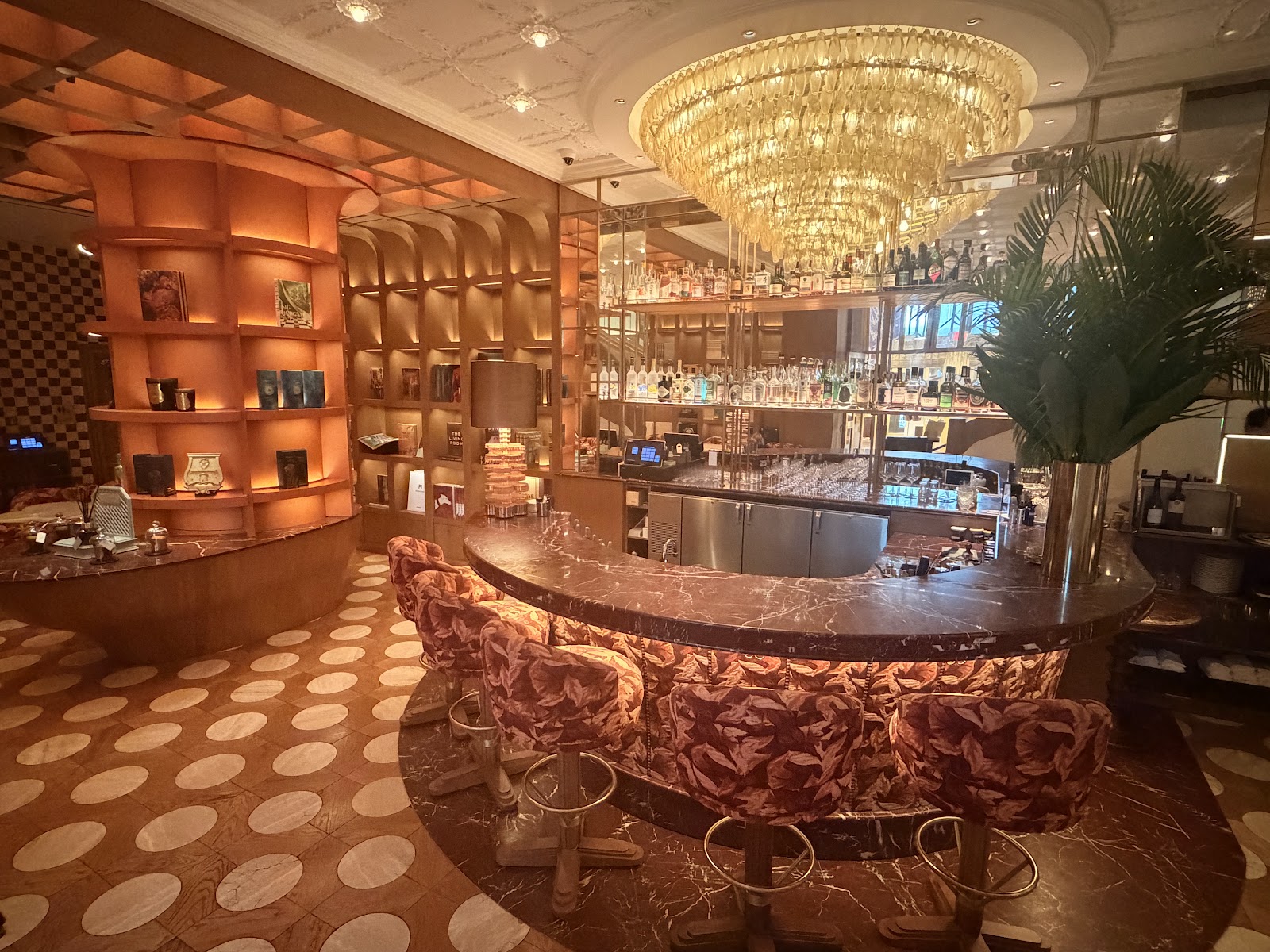
Walk into Maison Passerelle and you're not stepping into another millennial-minimalist fine-dining box. Laura Gonzalez's interior is a maximalist fever dream—emerald and burnt orange encaustic tiles, gilded murals, stained glass installations that catch the light like a fever, an open kitchen where you can watch every plate come together. It's the kind of room that demands you show up dressed, and means it. Perched on the 50th floor of 1 Wall Street, inside the only American Printemps, this is the dining equivalent of an event.
But the room's theatricality would mean nothing if Gregory Gourdet weren't cooking some of the most personal and purposeful food of his career. The three-time James Beard Award winner, who made his name in Portland at Kann, has built a menu that treats French classical cuisine as a foundation, not a ceiling. He's looking outward to Haiti, Vietnam, Senegal, Tahiti, and Morocco—not as exotic garnish, but as equal culinary partners. His mother's sos pwa, a white bean and aromatic purée served over white rice, sits alongside dishes glazed in cane syrup and finished with tamarind jus. It's both deeply personal and conceptually rigorous.
The execution is where Gourdet separates himself from the noise. A lobster cocktail arrives dressed in Creole cocktail sauce—the kind of move that sounds gimmicky until you taste it and realize he's just found the point where New Orleans and New York have always overlapped. Smoked beets with nuoc cham and pickled strawberries prove he understands that Vietnamese fish sauce and French beet preparations aren't enemies; they're waiting for the right hand to introduce them. An asparagus soup with crab and grilled cucumber feels light enough to float off the plate, but carries the weight of real technique.
That cane syrup duck, though—that's the dish people will book around. Glazed in cane syrup and finished with a tamarind jus, it's pure fireworks, a study in how Haitian culinary history and classic French protein cookery can speak the same language. Pair it with the jasmine rice with red kidney beans, and you've got something that is at once subtle, confident, and deeply satisfying. This is what happens when a chef stops thinking about culinary fusion and starts thinking about culinary honesty.
Maison Passerelle already has a Michelin star and a reservation queue that suggests booking a table requires either luck or patience. It's worth both. This is not a restaurant trying to be everything; it's one man's vision of what French cooking looks like when you refuse to forget where the ingredients actually came from.